⚖️ Legal Status at a Glance — Durrës, Albania
Overview
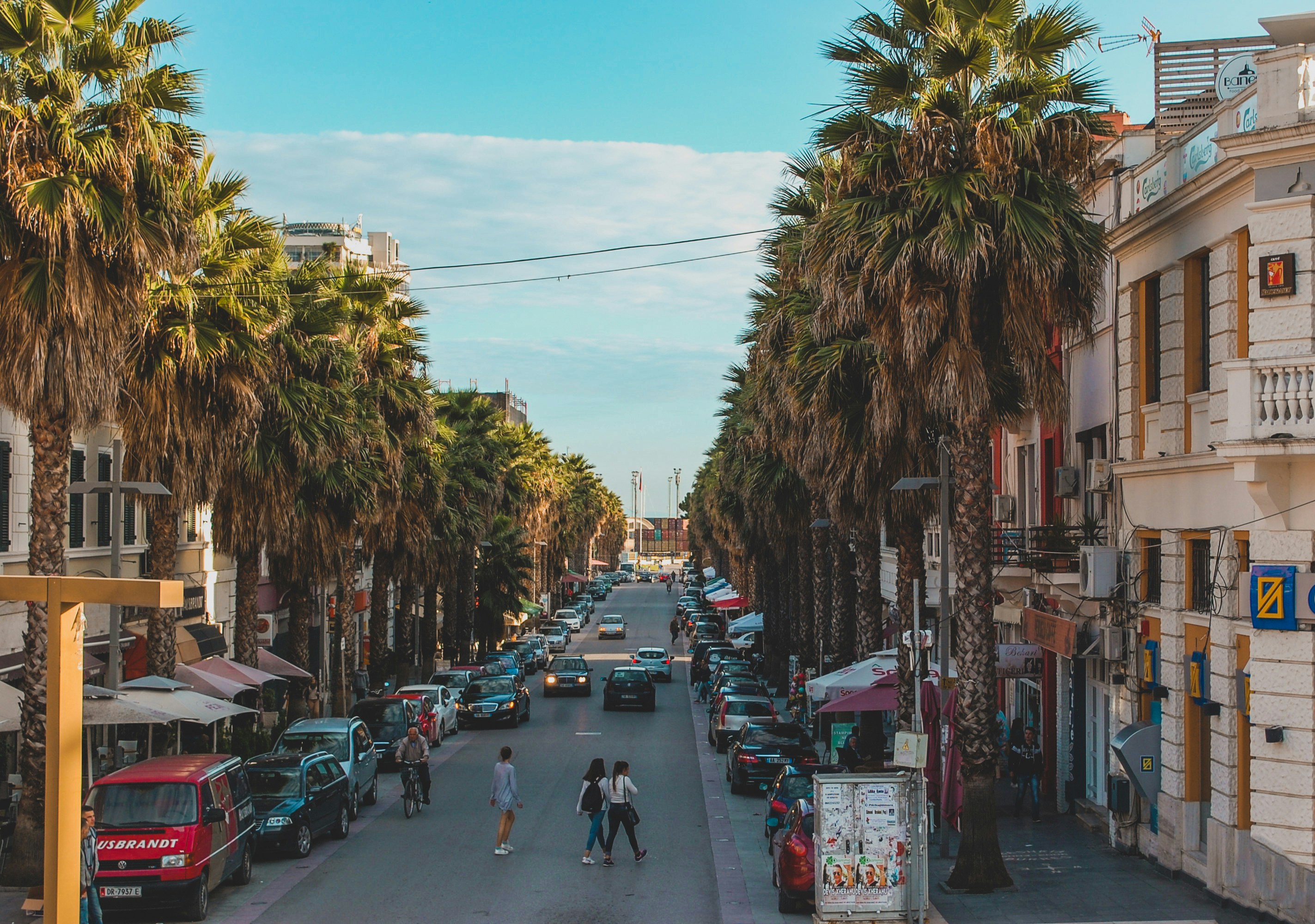
Durrës is Albania's second-largest city and primary port — the busiest in the country and one of the most active on the Adriatic. Ferry routes to Bari and Ancona in Italy make it the main maritime entry and exit point for tourists and freight alike. Beyond its port function, the city offers a long sandy beach, Greco-Roman ruins including a well-preserved amphitheatre, and a lively seafront strip drawing visitors through the summer season.
Durrës carries a second identity that shapes its cannabis law picture: this port has long been Albania's most active cannabis export gateway. Europol and UNODC identify the Adriatic corridor here as a primary route for cannabis reaching Western Europe.
Cannabis is fully illegal in Albania. There is no decriminalisation, no tolerance policy, and no exemption for tourists. Inside the city, enforcement falls overwhelmingly on the supply side — sellers and transporters, not individual consumers. But that distinction disappears entirely at the port. Do not carry cannabis through Durrës port. Port customs = import/export = trafficking, regardless of quantity.
The Law Right Now
Law No. 116/2016 and Article 283 of the Albanian Criminal Code govern cannabis. All forms — marijuana, hashish, oil — are Schedule I narcotics. Possession, cultivation, production, transport, import, export, and supply are all criminalised, with no exemptions for tourists.
Personal possession can in practice be treated as an administrative offence under Article 28 of Law 116/2016 — a fine plus mandatory treatment referral — but prosecutors retain full discretion to escalate to criminal charges. Tourists caught with small amounts face a difficult, costly situation, but rarely a criminal prosecution targeting them specifically. That is operational reality, not a legal protection, and it provides no cover at port checkpoints.
Trafficking (Article 283): base sentence 5–10 years; aggravated (organised crime, large quantities, cross-border) carries 10–20 years. Albanian and Italian authorities share intelligence and cooperate actively on the Adriatic route — the moment cannabis crosses the port threshold, it is a trafficking matter, minimum 5 years.
Medical cannabis: Law No. 61/2023 authorises licensed export cultivation only, with no domestic patient access. Cannabis-derived prescription medication needs a formal Ministry of Health import permit obtained before travel; arriving with it undeclared is a real risk at the checkpoint.
Realistic Consequences
The port's trafficking history is not a historical footnote — the cases keep coming. On 22 August 2026, Albanian police closed Operation "Anchor," an international investigation that traced roughly 80kg of high-grade "Gelato" cannabis shipped from Ontario, Canada, concealed in a specially modified compartment inside a vehicle, through Durrës port and onward toward Kosovo. Three Kosovar nationals aged 32, 26 and 40 were arrested at the port; two more suspects — one Albanian, one in Canada — remain wanted. Police seized three vehicles, five phones, and roughly €11,000 in cash, and put the shipment's street value near €1 million.
The case fits the port's established pattern: sophisticated, international, and prosecuted hard when caught. A tourist with a personal amount is not the profile customs is built to catch, but a vehicle boarding a ferry is searched far more readily than a pedestrian — assume the trunk gets checked.
The route did not slow down after that arrest. On 9 September 2026, police announced Operation "Anchor 2," seizing a further 107.7kg of the same "Gelato" cannabis strain from Canada hidden in a shipping container at Durrës port, alongside two vehicles and a camper van used to move it onward. This time no one was caught on the spot — two suspects were declared wanted rather than arrested — showing the smugglers adapting their handoff after the first bust rather than abandoning the route.
A BIRN investigation published 18 September 2026 put both busts in context: they are two of three shipments — the third, 46kg seized at Rinas Airport off a Toronto flight on 28 August 2026 — that moved a combined 233.7kg of Canadian cannabis worth roughly €2.45 million into Albania in just 19 days. The reporting frames this as a structural shift: Albania's cannabis trade, long associated with outdoor fields in villages like Lazarat, is moving toward imported, high-potency product routed through ports and airports — with Durrës at the centre of it.
📡 Regulation Pulse
- Operation "Anchor" (August 2026): three Kosovar nationals arrested at Durrës port over an 80kg cannabis shipment from Canada worth roughly €1 million — two suspects still at large.
- Operation "Anchor 2" (9 September 2026): a further 107.7kg of Canadian "Gelato" cannabis seized in a shipping container at Durrës port; two suspects declared wanted, no arrests this time.
- EU accession negotiations ongoing (formal talks opened 2022); European Commission monitoring rule-of-law and drug enforcement under Chapters 23/24 — sustained pressure on enforcement accountability at Durrës port given its trafficking history.
- Law No. 61/2023 medical cannabis export framework: licensed cultivation facilities becoming operational; no domestic patient access programme planned — unrelated to the legal situation of visitors or transit passengers.
- BIRN investigation (18 September 2026): found three shipments totalling 233.7kg of cannabis (~€2.45 million) moved through Durrës port and Rinas Airport in just 19 days (22 August–9 September 2026) — evidence Albania's trafficking model is shifting from Lazarat-style domestic cultivation toward imported Canadian "Gelato" cannabis.
Public Sentiment
There is no meaningful domestic constituency pushing for cannabis liberalisation; EU accession and rule-of-law reform dominate civil society attention instead. Public discourse is shaped by Albania's history as a producer and exporter — coverage centres on organised crime and trafficking, not consumer rights.
Practical Advice for Visitors
Do not carry cannabis through Durrës port. The Adriatic crossing to Italy is Albania's most monitored trafficking corridor. Any quantity, any direction, is import/export — trafficking, minimum 5 years.
Within the city, enforcement falls overwhelmingly on sellers and transporters, not individual consumers — a tourist with a small personal amount typically faces an administrative process rather than prosecution. That is not a legal right, and it provides no cover at or near the port, as Operation "Anchor" shows.
Vehicles passing through the port are searched. Cannabis has been detected in vehicles on the Durrës–Italy route repeatedly, including inside a purpose-built compartment. Discovery in a vehicle is treated as trafficking, not personal possession.
CBD and hemp-derived products are a grey zone. Albanian law does not clearly distinguish low-THC hemp from cannabis. Port officers without specialist testing equipment may treat a CBD supplement as a controlled substance, even if it's legal where you bought it.
If detained: invoke your right to consular notification immediately under the Vienna Convention on Consular Relations. Do not sign documents you have not fully understood. Informal payments to resolve minor situations carry extortion risk and provide no legal resolution — seek formal legal representation as early as possible.
Comments
Leave a Comment