⚖️ Legal Status at a Glance — Sarandë, Albania
Overview
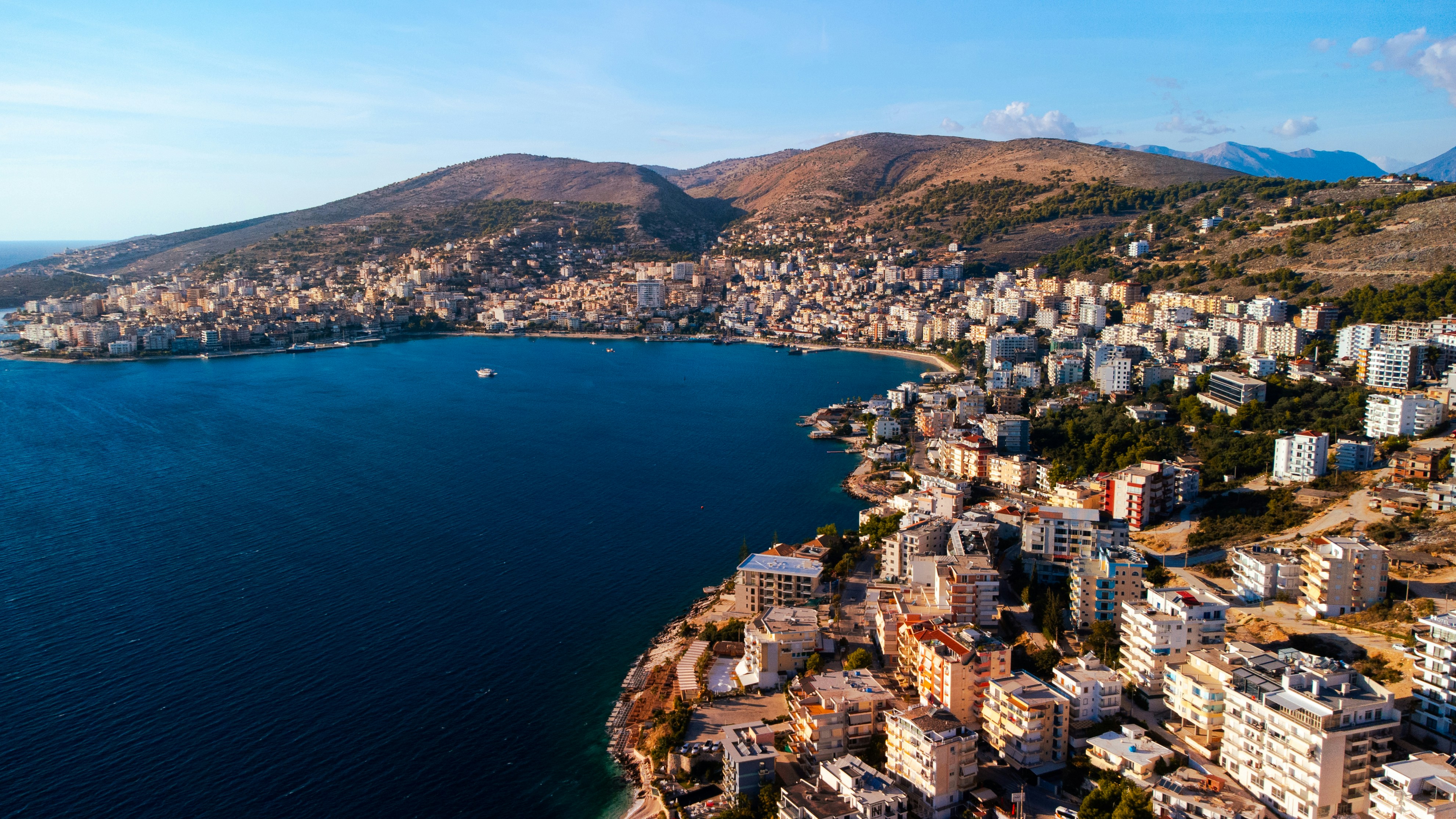
Sarandë is Albania's southernmost coastal city — the tip of the Albanian Riviera on the Ionian Sea, directly opposite Corfu across a 35-minute channel crossing. Visitors move between Greece and Albania via the Corfu ferry or the Kakavija land border. Its seafront promenade, warm clear water, and low costs relative to Western Europe have made it one of the country's fastest-growing summer destinations — with nearby Ksamil now part of the same enforcement picture.
That geography defines the cannabis risk picture here. Sarandë is a transit point between two countries with very different enforcement cultures: Greece has decriminalised small-quantity possession; Albania has not. The gap does not create a grey zone — it creates a hard border, monitored by customs and police. Cannabis is fully illegal in Albania. There is no decriminalisation, no tolerance policy, and no exemption for tourists — Albanian law applies from the moment you step off the ferry.
The Law Right Now
Law No. 116/2016 and Article 283 of the Albanian Criminal Code govern cannabis. All forms — marijuana, hashish, oil — are Schedule I narcotics. Possession, use, cultivation, transport, import, export, and supply are criminalised across the board.
Personal possession can in practice be treated as an administrative offence under Article 28 of Law 116/2016 — a fine and mandatory treatment referral rather than criminal prosecution — but prosecutors retain full discretion to escalate at any time. Away from the border, enforcement often focuses on supply rather than individual consumers, but there is no guaranteed leniency and no defined legal threshold for "personal use."
Trafficking (Article 283): base sentence 5–10 years; aggravated circumstances — organised crime, large quantities, cross-border movement — carry 10–20 years. Do not carry cannabis on the Corfu–Sarandë ferry or across the Kakavija land border. Import equals trafficking, minimum 5 years, regardless of quantity — Greece's more permissive attitude does not transfer once you step off the ferry.
Medical cannabis: Law No. 61/2023 authorises licensed cultivation for export only — no domestic patient access, no dispensary system, no Albanian medical cannabis card. A cannabis-derived prescription medication (e.g. Sativex) needs a formal import permit from the Albanian Ministry of Health obtained before travel; arriving with it undeclared is a real legal risk.
Realistic Consequences
On 6 September 2026, police closed Operation "Vjeshta," a two-month investigation that dismantled a network selling cannabis and cocaine "in beach areas, nightlife establishments and near schools" across Sarandë, with distribution reaching Ksamil. Twenty people were arrested and ordered into pre-trial detention; two more remain wanted. Police seized two pistols, four vehicles, and nineteen phones. It followed a smaller case on 1 August 2026: Operation "Transportuesit" stopped a run on the Nivicë–Sarandë road near the Kakomesë bridge, arresting three people carrying 5kg of cannabis in two cars, one driving ahead purely to watch for police.
Court filings unsealed when the Saranda District Court formally remanded all 20 "Vjeshta" suspects into custody on 8 September 2026 filled in the picture: the two-month probe (case no. 442/2026) used undercover buys and covert audio surveillance to trace sales in exactly the places a visitor would pass through — beaches, the seafront promenade, beach bars, and areas near gyms and schools — with doses of 0.3–3.5g priced at 2,000 to 35,000 lekë. Investigators say the cannabis was sourced from Shenvasil village and that foreign nationals were involved on the buying side too, purchasing in bulk for onward redistribution — a detail that undercuts any assumption that dealing here is a purely local, low-stakes affair.
None of this sits at the border — but the border adds its own layer. In June 2026, Greek authorities seized nearly 97kg of raw cannabis at the Greek–Albanian frontier, suspected trafficked out through Sarandë and Konispol's rural crossings on the "green border." The pattern is unambiguous: dealing networks reaching into beach areas get dismantled, smuggling routes toward Greece stay watched, and a tourist's realistic exposure is confiscation and paperwork for personal amounts — rising sharply near Kakavija or on the water.
📡 Regulation Pulse
- Operation "Vjeshta" (September 2026): 20 arrested as police dismantled a cannabis/cocaine network selling specifically to tourists at beaches and beach bars in Sarandë and Ksamil; the Saranda District Court remanded all 20 into custody on 8 September 2026.
- Operation "Transportuesit" (August 2026): three arrested carrying 5kg of cannabis on the Nivicë–Sarandë road, using a lookout car to watch for police.
- Greek border seizure (June 2026): ~97kg of raw cannabis intercepted at the Greek–Albanian frontier, suspected to have moved out through Sarandë and Konispol's rural crossings.
- EU accession negotiations ongoing (formal talks opened 2022); European Commission monitoring rule-of-law and drug enforcement under Chapters 23/24 — sustained pressure on enforcement accountability, no change to the substance of cannabis law.
Public Sentiment
There is no meaningful domestic constituency pushing for cannabis liberalisation; EU accession and rule-of-law reform dominate civil society attention instead. Public discourse is shaped by Albania's history as a producer and exporter — coverage centres on organised crime and trafficking, not consumer rights.
Practical Advice for Visitors
Do not carry cannabis on the Corfu–Sarandë ferry or across the Kakavija land border. This is non-negotiable. Import is trafficking regardless of quantity — minimum 5 years. Leave anything behind before you board or cross; what was tolerated in Corfu is irrelevant once Albanian jurisdiction begins.
Avoid beach clubs and nightlife venues known for dealing, including in Ksamil. "Vjeshta" showed exactly where police attention is concentrated — buying there puts you near people under active investigation, not just legal exposure of your own.
Within Sarandë city, the risk to tourists falls short of the risk to sellers, who face years in prison. A tourist with a small personal amount is more likely to face an administrative process than prosecution — but that disappears entirely at or near the border zone.
CBD and hemp-derived products are a grey zone. Albanian law does not clearly distinguish low-THC hemp products from cannabis. A border officer without specialist testing equipment may treat a CBD supplement as a controlled substance. Leave such products at home unless you have explicit written authorisation.
If detained: invoke your right to consular notification immediately under the Vienna Convention on Consular Relations. Do not sign documents you have not fully understood. Seek formal legal representation as early as possible.
Comments
Leave a Comment